


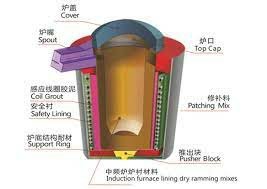
Refractory materials are the basic materials in the field of high temperature technology. The most common application of refractory materials is in various thermal equipment and high temperature containers as structural materials and linings that resist high temperature. In the iron and steel metallurgical industry, coke ovens are mainly composed of refractory materials. Iron-making blast furnaces and hot blast furnaces, various steel-making furnaces, soaking furnaces, heating furnaces, etc. are all indispensable for all kinds of refractory materials that meet the requirements.
Not only does the die casting of molten steel consume a lot of refractory materials, but continuous casting also requires some high-quality refractory materials. Out-of-furnace refining cannot be achieved without high-quality refractory materials.
Statistics show that the iron and steel industry is the sector that needs the most refractory materials, accounting for about 60% of the total output of refractory materials.
Pyrometallurgy and thermal processing of non-ferrous metals are also inseparable from refractory materials.
All high-temperature furnaces or their linings in the building materials industry and other high-temperature operating sectors that produce silicate products, such as the glass industry, cement industry, and ceramics industry, must be constructed of refractory materials.
Refractory materials are required for various roasting furnaces, sintering furnaces, heating furnaces, boilers and their associated fire channels, chimneys, and protective layers in other industrial high-temperature operating sectors such as chemical industry, power, and machinery manufacturing.

Application fields of refractory materials:
There are many kinds of refractory materials and different uses. They are mainly used in various fields of the national economy such as steel, non-ferrous metals, glass, cement, ceramics, petrochemicals, machinery, boilers, light industry, electric power, and military industry. The development of essential basic materials plays an irreplaceable role in the development of high-temperature industrial production.
There are many classification methods for refractory materials.
Among them, there are many methods such as chemical attribute classification, chemical mineral composition classification, production process classification, and material form classification.
Today, SMR will give you a detailed explanation from two classification methods:
- According to the level of refractoriness:
Ordinary refractory material: 1580℃~1770℃
Medium refractory: 1770℃~2000℃
Advanced refractory material: >2000℃
- According to the different shapes and sizes of products:
Standard type: 230mm×114mm×65mm, no more than 4 measuring rulers, (size ratio) Max:Min<4:1
Special shape: no more than 2 concave corners, (size ratio) Max:Min<6:1 or an acute angle of 50-70°
Idiosyncratic: (size ratio) Max:Min<8:1 or no more than 4 concave angles; or an acute angle of 30-50°
Special products: crucibles, utensils, tubes, etc.


